
HD Video Download
Save X (Twitter) videos as MP4 up to 1080p Full HD — every quality the post published.
Paste any X (Twitter) post link with audio, and the tool downloads the source MP4, then converts the audio track to MP3 entirely on your device using ffmpeg.wasm. Nothing is uploaded to a server, no plug-in is installed, and the finished file lands in your Downloads folder in a few seconds. This is the fastest way to strip audio from a tweet without stitching together separate tools.
Paste an X (Twitter) post URL, press Download, and the tool extracts just the audio track from the source video into a 320 kbps CBR MP3 — the whole conversion runs on your device via ffmpeg.wasm, so nothing about the video or the tweet URL is uploaded to us.
Four workflows drive most of the traffic. Podcast listeners strip highlight clips from interview tweets — the podcast-clip playbook covers building a supercut from a thread. DJs and producers grab covers, remixes and beat snippets creators post directly to X. Journalists and language learners archive native-speaker voice notes for reference and transcription.
Our full bitrate and settings guide explains why 320 CBR is a safer default than VBR when the MP3 will later be re-encoded by a podcast host or DAW. On the mobile side, the iPhone walkthrough covers the exact Files-app landing spot and how to route the MP3 into Voice Memos, Apple Music or a podcast client — no app install required.
The MP3 page is a different intent from normal video saving. Visitors are looking for audio: podcast clips, speeches, music snippets, voice notes, interviews and spaces-style recordings posted as video. The page explains that the source is still a Twitter/X video, then extracts the audio track into a normal MP3 file that plays in podcast apps, car audio systems, editors and music libraries. That makes the page more relevant for twitter to mp3 and twitter mp3 downloader searches than a generic video page with an MP3 tab.
| Feature | Tweet Viewer | SSSTwitter | SaveTweetVid | SnapX |
|---|---|---|---|---|
| MP3 output | Yes | Usually video only | Usually video only | Usually video only |
| Best for | Podcasts, music clips, interviews, voice notes | Saving the video | Saving the video | Saving the video |
| No install | Browser-based conversion | Browser-based video save | Browser-based video save | Browser-based video save |
| Account needed | No | No | No | No |
Open the X (Twitter) post whose audio you want. Tap the share icon and choose “Copy link,” or copy the URL straight from your browser's address bar.
Paste the copied URL into the input at the top. The MP3 tab is already selected, so the tool knows to prepare the file as audio.
Press Download. The audio track is extracted from the source video with ffmpeg.wasm — entirely in your browser, nothing uploaded — and the finished MP3 lands in your Downloads folder in seconds.
By default the converter targets a 128 kbps MP3, which is a clean match for most X video audio (typically 128 kbps AAC in the source MP4). Because MP3 is transcoded from the compressed source, output quality is bounded by whatever X hosts — expect faithful reproduction for speech, music clips and podcasts, but don't expect a 128 kbps podcast clip to become studio quality just by changing container.
The MP3 tab is popular for saving podcast snippets, capturing music covers and remixes shared on X, keeping voice notes from creators, archiving spoken interviews, and pulling audio out of long clips so you can listen while driving or working out — anywhere a video file is inconvenient. Because MP3 is universally supported, the file plays on any phone, car stereo or MP3 player without extra software.
Save X (Twitter) videos as MP4 up to 1080p Full HD — every quality the post published.
Paste dozens of links and get a single .zip with every video.
Extract audio from any X video and save it as MP3 — great for podcasts, music and voice clips.
Render any X post as a clean PNG image — perfect for articles, decks and reposts.
View any public profile, tweet, photo or video anonymously — no account, no login.
Save any GIF posted on X, or turn an X video into a shareable animated GIF.
Anonymous, unlimited, and 100% free — the file you get is the original MP4.
We never store your links or track your downloads. Runs in the browser — nothing to install.
It is a free browser tool that extracts the audio from any public Twitter (X) video and saves it as an MP3. Paste the post link, pick the bitrate, and download — no login, no app install, and no watermark.
No. The MP3 downloader requires no account or login. Everything runs in your browser and your X credentials are never requested, so your account stays private.
The converter outputs a 128 kbps MP3, which matches the audio bitrate X typically ships. Speech and most music clips sound identical to the original tweet playback.
Yes. The conversion runs inside Safari on iPhone using WebAssembly, and the MP3 saves to Files. You may see a permission prompt the first time you save a file — allow it and the download starts.
No. Private, protected or DRM-restricted posts can't be accessed by the downloader — you can only extract MP3 from publicly visible X posts.
Much smaller. Stripping the video track typically reduces the file by 80–95 percent, so a 40 MB tweet video becomes a 2–6 MB MP3, depending on length.
Yes — the output is a pure MP3 audio file with no embedded video, so it plays anywhere audio does and can be added to any podcast or music app.
Paste the X post URL into the box at the top of this page, make sure the MP3 tab is selected (it's the default here), and press Download. The Twitter to MP3 converter extracts the audio track on-device and hands you back an MP3 in seconds — no upload to any server, no signup, no queue. The finished file drops straight into your Downloads folder.
Yes — that is exactly what the MP3 tab does. Instead of pulling the full MP4, it fetches the video, strips the H.264 video track, and re-muxes the AAC audio into an MP3 container. You get a small audio-only file with the video discarded. Handy for podcasts clipped from interviews, music snippets, or voice-over posts you want to listen to on the go.
128 kbps by default, transcoded from the source AAC track that X ships (typically also around 128 kbps AAC). Because AAC at 128 kbps and MP3 at 128 kbps sound roughly equivalent for speech and most music, the conversion is essentially transparent — you shouldn't hear a difference from the original tweet playback. There's no lossless option since the source itself is already lossy.
X's Terms of Service allow saving your own content freely, and public content under standard fair-use principles for personal reference, commentary, criticism, or education — the same rules that apply to any downloaded media. You should not redistribute copyrighted audio commercially or republish it in a way that competes with the original. When in doubt, credit the source and link back to the original post.
Indirectly, yes. Live audio-only Spaces don't have a downloadable URL while running, but once the host publishes the replay, run the Space's post URL through the MP4 downloader first to get the MP4, then bring that MP4 back to this MP3 tab. Two steps, but the end result is a clean audio-only MP3 of the entire Space recording.
Open Safari on iPhone, paste the X post URL into the box above, tap the MP3 tab, and press Download. Safari will ask permission the first time to save a file — allow it and the MP3 drops into the Files app under Downloads. From there, long-press the file to move it to a folder, share it to another app, or open it in the Music or Voice Memos app for playback.
Yes — the Twitter to MP3 converter is completely free with unlimited conversions, no login, no email, and no watermark. The heavy lifting runs in your browser using WebAssembly, so there's no server cost for us to pass on. Convert one clip or two hundred in a day; nothing gates the flow. There are no paid tiers or premium formats hidden behind a signup wall.
That's a source-audio limitation, not the converter. X does not apply loudness normalization on upload, so tweet videos ship at whatever level the creator recorded them — often 6 to 12 dB below broadcast standard. The MP3 preserves that exact level bit-for-bit. If you need a louder file, pull it into a player like VLC and boost the gain, or run it through a normalizer like ffmpeg's loudnorm filter.
On iPhone, everything happens inside Safari — there's no app to install. Paste the post URL, pick the MP3 tab, tap Download, and confirm the save prompt. iOS will drop the MP3 into the Files app under Downloads (or your chosen folder). From there you can AirDrop it, move it into a Voice Memos or Music folder, or open it in a third-party player like VLC. The full iPhone walkthrough covers Shortcuts integration and background playback tips for longer clips.
No. The converter is a plain web page — nothing to install, no extension to sideload, no desktop client to keep updated. Everything runs inside the tab you already have open. That means it works identically on Windows, macOS, Linux, ChromeOS, iOS and Android, and you can use it on a locked-down work laptop where installing software is blocked. For a deeper look at how a no-install browser-based workflow compares to legacy desktop rippers, we broke it down in the blog.
For X-sourced audio, 128 kbps is the honest answer. The upstream track is roughly 128 kbps AAC, so transcoding to 320 kbps MP3 just pads the file with padding bytes — it doesn't invent detail that wasn't in the source. You'd only pick a higher bitrate if you plan to re-encode the file again later and want to preserve headroom. If you're storing lots of clips on a phone, 128 kbps also cuts the size roughly 60%. Our MP3 quality settings guide shows the null-test spectrograms.
Not in a single click, but the workflow takes about ten seconds. Run the URL through the HD MP4 downloader first to save the full-quality video, then paste the same URL back into this MP3 tab to extract the audio track. Both tools run on-device, so you're not re-uploading anything, and the two outputs come from the same source file — the MP3 is bit-identical to the audio inside the MP4. Handy when you want a shareable video and a listen-on-the-go audio copy.
For personal listening — clipping a podcast excerpt to hear later, saving a voice-over you liked, keeping a copy of a lecture — most people treat it the same as bookmarking. Where it gets murky is music: songs uploaded to X are still owned by their rights holders, so re-uploading, remixing, or monetizing that audio elsewhere can run into copyright issues. Credit creators, don't republish other people's music commercially, and when in doubt ask the poster. Our general FAQ covers this in more detail.
No. The transcoding step uses ffmpeg.wasm, which is a WebAssembly build of ffmpeg that runs entirely inside your browser tab. When you paste the URL, your browser fetches the source video directly from X's CDN, then ffmpeg.wasm strips the video and writes the MP3 to your local disk. We never see the URL, the video, or the finished MP3 — there's no server-side conversion queue. If you want the technical details, our privacy page spells out exactly what does and doesn't leave your device.
The web tool is the safer bet. MP3-ripping extensions have a habit of getting pulled from the Chrome Web Store — for policy violations, for silently swapping to affiliate redirectors after ownership changes, or because the original maintainer quit and a new owner injected ad code. When Google pulls the listing, your installed copy stops receiving security updates and any bug becomes permanent. A plain web tool needs no install permissions and cannot read the other tabs you have open. Our MP3 quality guide also covers why the browser tab matches native encode quality.
Yes — any modern Chromium browser (Chrome, Edge, Brave, Arc, Opera), Firefox, or Safari on macOS handles the conversion identically. There is no Windows-only build, no Mac App Store version, and no separate Linux download — the whole tool is a single web page. The MP3 lands in your default Downloads folder and plays back in Groove, Windows Media Player, QuickTime, VLC, or iTunes without any codec install. Our no-install desktop walkthrough compares the browser flow against legacy desktop rippers side-by-side.
This isn't legal advice, and the honest answer varies by jurisdiction. In most places, ripping public audio for private, personal listening — a lecture clip, a podcast excerpt, a voice note — is treated similarly to bookmarking a page. Ripping copyrighted music tracks and redistributing them, monetizing the file, or bypassing DRM is where you'll run into trouble under laws like the DMCA in the US or the EU Copyright Directive. Check X's Terms of Service and your local copyright rules, and when a track is clearly commercial music, credit the rights holder or license it properly rather than reuploading the MP3.
On your device, start to finish. ffmpeg.wasm is a WebAssembly compile of ffmpeg that ships as part of the page and runs in the same tab you have open — the source MP4 is fetched into a memory buffer, the AAC track is demuxed, the MP3 is written back to disk, and none of those bytes touch our server. There is no upload queue, no conversion worker, and no temporary file on our end. The only lookup is the one your browser makes to the public FxTwitter API to find the tweet's video URL — our server is not involved at all. Full breakdown on our privacy page.
Yes, and it's the standard move for podcast clippers and archivists. Paste your list of X post URLs into the Twitter bulk downloader first to grab all the MP4s in a single .zip, unzip them locally, then bring the ones you actually want as audio back to this MP3 tab one at a time. Two passes rather than one, but you keep the video originals as a reference archive and only re-encode the clips you're actually going to use — no wasted disk on 40 MB MP4s of two-minute voice notes you'll only hear once.
Failures almost always fall into three buckets. Private or protected posts return an authorization error the tool cannot bypass — request the video from the poster directly. Deleted posts return a 404, which no tool can recover. And posts whose media is images-only or a text-only quote-tweet have no audio track to extract, so the MP3 pass has nothing to work on. If the tweet is clearly public, plays for a logged-out viewer on x.com, and contains video, retry once — X's CDN occasionally throttles — and if it still fails, send us the URL through the contact page so we can investigate.
Tweet Viewer is a free, browser-based Twitter (X) toolkit that lets you save any public post as an HD MP4 video, an MP3 audio file, a batch .zip archive, or a clean PNG screenshot — all without logging into X or installing an app.
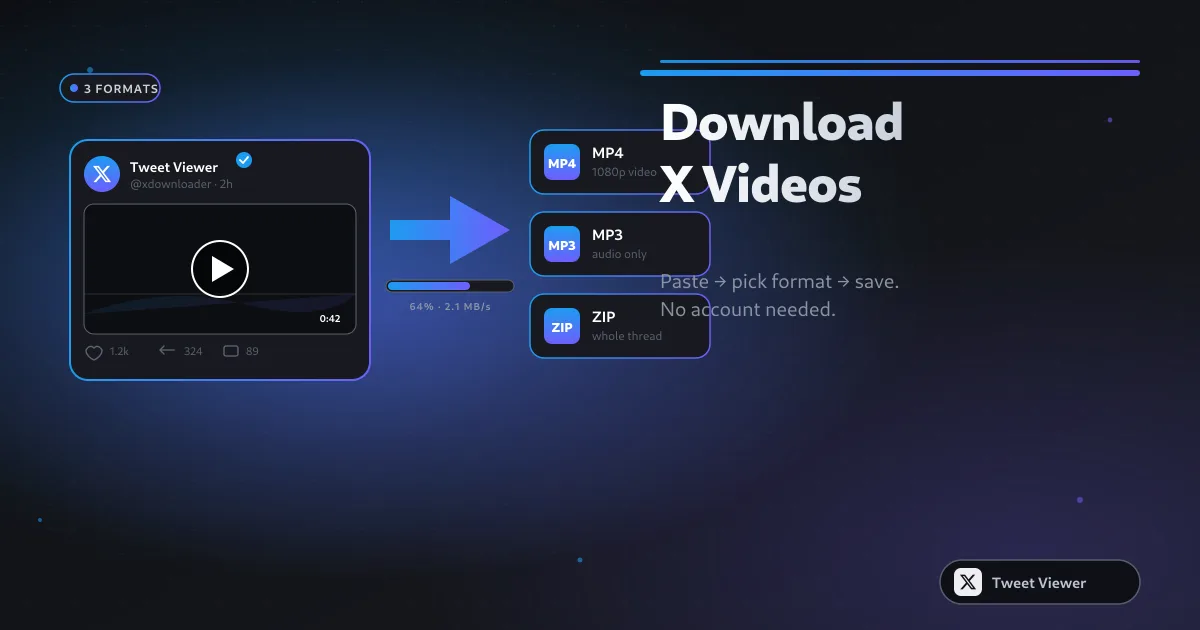
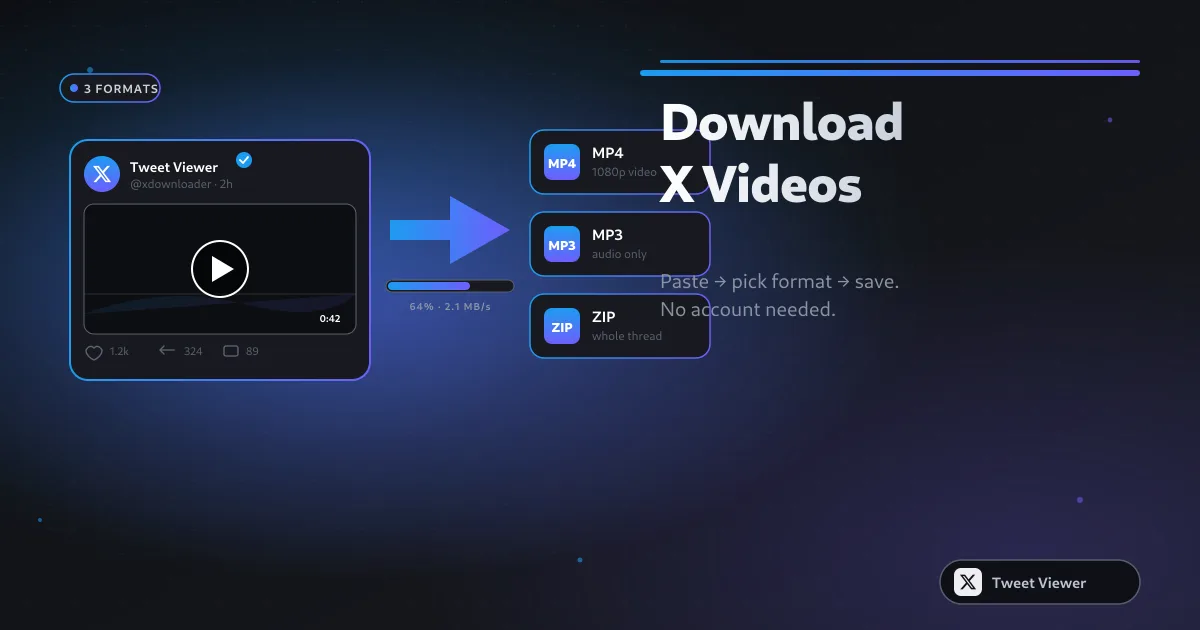
Tweet Viewer is not a single tool but a suite of distinct functions. The HD MP4 downloader saves any tweet's video at up to 1080p Full HD. The Bulk Downloader accepts a list of X links and returns them as a single .zip archive. The MP3 Converter extracts the audio track from a video tweet on-device using ffmpeg.wasm. The Screenshot tool renders any tweet as a high-resolution PNG. The GIF Downloader saves GIFs posted on X or converts a video into a shareable animated GIF. And the Twitter Viewer lets you browse any public profile, tweet or media anonymously — no account or login.
Four groups make up most of the traffic here. Everyday users who saw a video on X and want to keep it, content creators archiving their own posts and reference footage, journalists preserving newsworthy tweets before deletion, and marketers pulling brand and competitor content for analysis. None of them want an account, a subscription or a watermark — and none of them get one.
The most common reason people arrive at Tweet Viewer is a single need: save a specific tweet's video without logging into X. Paste the post link into the box above, press Download, choose 1080p / 720p / SD, and the MP4 lands in your Downloads folder in seconds. No X account is used, no login prompt appears, and the file is the exact same MP4 X served in the browser.
Tweet Viewer's tools save Twitter content at the same quality X serves it — no re-encoding, no watermark, no forced 720p cap. Videos come through as clean MP4, audio as 128 kbps MP3, screenshots as retina-quality PNG, and batches as a single .zip. What you download is exactly what was posted.
Many users arrive from searches for alternatives to SSSTwitter, SSSX, TwitterVideoDownloader, SnapX, SaveTwt, XSaver, SaveTweetVid, TWDown, TwDownloader, Twdownload, Snaptwitter and various "Twitter to MP3" tools. Tweet Viewer serves as a unified replacement for all of them — five tools in one browser tab, no ad-loaded redirect page between paste and download, and no premium tier hiding higher-quality output.
Tweet Viewer requests zero permissions. It does not ask for your X username, password, or account access. Your browser looks up the post you paste directly with the public FxTwitter API and streams the media from X's public CDN straight to your device — our server never sees the link, and nothing about it is stored.
Copy any public X (Twitter) post link. Paste it into the box above. Press Download. Choose the tab that matches what you want — MP4 video, MP3 audio, Screenshot PNG, or Bulk .zip if you have multiple links — and the file drops straight into your Downloads folder on iPhone, Android, Windows or Mac. Still stuck? Our FAQ covers the common gotchas.